


May 15, 2026
Sialkot Built Trionda Revealed as Official Adidas 2026 World Cup Ball
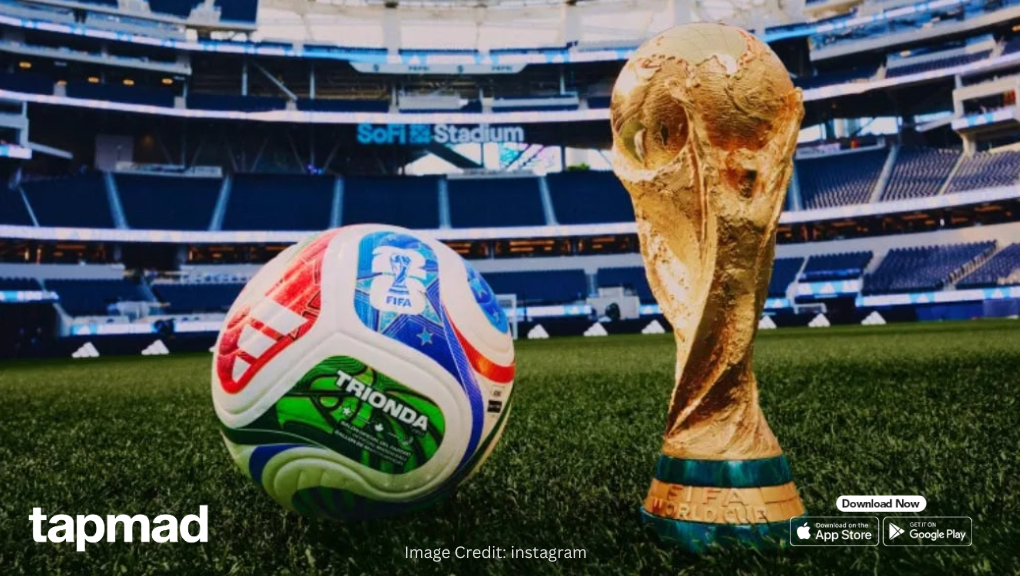

The global sports manufacturing industry is centering its attention on Sialkot, Pakistan, as the FIFA World Cup 2026 approaches. While international tournaments spotlight elite athletes and corporate sponsors, the physical foundation of the world’s largest sporting event is built by Pakistani artisans.
Sialkot factories produce roughly 70% of the world's premium soccer balls, supplying the elite equipment that dictates the pace of modern professional play.
For the 2026 tournament, hosted across 16 cities in Canada, Mexico, and the United States, the official match ball is named the Trionda.
By blending Adidas's design blueprints with Sialkot's manufacturing expertise, the Trionda stands as a massive milestone for Pakistan's manufacturing industry.
Technical Specifications Of Sialkot-Built Trionda Pro
The 2026 World Cup ball balances data tracking with high-performance flight physics. The table below outlines the core material attributes of the Adidas Trionda Pro version built on Forward Sports' automated production lines:
|
Attribute / Layer |
Specification |
Performance Benefit |
|
Official Name |
Trionda Pro |
Derived from "tri" (three hosts) and "onda" (Spanish for wave) |
|
Designer / Brand |
Adidas |
Global patent holder, branding, and distribution network [1] |
|
Manufacturer |
Forward Sports (Sialkot, Pakistan) |
Premium manufacturing quality control and assembly |
|
Outer Skin |
100% High-Performance Polyurethane (PU) |
Sustainable skin using water-based inks and bio-based materials |
|
Internal Bladder |
High-Grade Butyl Rubber |
Maximum air retention and shape permanence |
|
Construction Method |
Thermally Bonded Seamless Panels |
Fuses panels to eliminate water absorption and surface dead spots |
|
Panel Count |
4 Panels |
Fewest panels in World Cup history for a larger strike zone |
|
Sensor Package |
Suspension-Mounted 500Hz Motion Chip |
Transmits real-time spatial positioning data for VAR decisions |
|
Certification |
FIFA Quality Pro Certified |
Exceeds elite weight, size, and bounce metrics |
Sialkot’s Evolution: From Colonial Craft to Thermobonded Tech
Sialkot's status as a global sports equipment powerhouse dates back to colonial times.
The Shift to Synthetic Materials
During the 1980s, the sport shifted from natural leather to synthetic water-resistant coatings to prevent balls from becoming waterlogged and heavy. Sialkot's manufacturing hubs quickly adapted, training thousands of local technicians to manipulate high-grade polyurethane and composite synthetic layers.
The Thermobonding Revolution
The most critical evolution occurred during the 2014 tournament cycle. Traditional stitching was replaced by advanced thermal bonding, an assembly process where panels are chemically welded inside a heated mold.
Forward Sports built specialized automated production lines in Sialkot, proving the region could deliver seamless, aerodynamically stable match balls at scale.
FIFA World Cup Production History
Sialkot's industrial relationship with Adidas and FIFA tournaments spans more than four decades:
- 1982 (Tango Espana): Marked the early expansion of Sialkot-sourced hand-stitched balls onto football's grandest international stage.
- 2014 (Brazuca): Forward Sports stepped in to manufacture the official match ball for the tournament in Brazil.
- 2018 (Telstar 18): Sialkot factories produced the structurally revamped tournament ball used across Russia.
- 2022 (Al Rihla): Sialkot fabricated the match balls deployed in Qatar, introducing an internal suspension system to support real-time VAR tracking data.
- 2026 (Trionda): The latest milestone confirms Sialkot will produce the official match balls for the expanded 48-team tournament hosted by Canada, Mexico, and the United States.
Strategic Engineering and Aero-Acoustic Innovations of Sialkot-built Trionda
The design of the Trionda focuses heavily on flight predictability across different playing conditions.
1. Four-Panel Seamless Architecture
The Trionda features a specialized construction method consisting of just four major panels, representing the lowest panel count ever implemented for a men’s World Cup tournament ball. By significantly minimizing the absolute number of panel intersections, the ball introduces a much larger, unobstructed strike zone.
2. High-In-Flight Seam Engineering
To eliminate the unstable aerodynamic behavior known as "knuckling", a phenomenon that heavily disrupted goalkeepers during earlier tournaments, the Trionda relies on deep, strategically positioned seams alongside textured debossing.
3. All-Weather Environmental Stability
The 2026 tournament features severe climate variations, stretching from high-altitude venues in Mexico to varying humidity levels in the United States and Canada. The non-stitched, thermally welded outer skin forms a seamless moisture barrier. This architecture restricts water uptake to near-zero percent.
Integrated Connected Ball Technology
The Trionda contains an internal data tracking mechanism designed to work with FIFA's semi-automated offside technology and video assistant review (VAR) tools.
- 500Hz Motion Sensor Chip: Anchored firmly at the geometric center of the ball by a specialized suspension system, this sensor captures spatial positioning data 500 times per second.
- Instantaneous Touch Detection: The tracking system logs the exact microsecond a player makes contact with the ball, providing precise insight into pass releases and deflections.
- Synchronized Stadium Telemetry: Real-time data streams link directly with optical tracking cameras arranged around each venue, helping officials map player limbs relative to the ball to quickly resolve tight offside calls.
- Factory Calibration: Sialkot technicians precisely calibrate this suspension system to ensure the electronic components remain perfectly centered through high-velocity strikes against goalposts.
Symbolic Aesthetics Adidas Trionda: Celebrating "La Ola"
The visual identity is directly inspired by the world-famous "Mexican Wave" (La Ola), a crowd phenomenon that achieved widespread global recognition during the 1986 FIFA World Cup in Mexico.
The ball features a striking tricolor graphic schema consisting of vibrant red, green, and blue waves. These paths elegantly merge abstract representations of national iconography:
- The Red Wave: Pays tribute to Canada, embedding subtle cues of the iconic maple leaf.
- The Green Wave: Represents Mexico, capturing the swift energy of the golden eagle.
- The Blue Wave: Honors the United States, displaying geometric layouts inspired by the sovereign star.
The Expanded FIFA World Cup 2026
The technical design of the Trionda directly matches the requirements of a massive, restructured tournament ecosystem.
Expanded 48-Team Format
The 2026 iteration marks a historic change, expanding the final field from 32 teams to 48 nations. This growth increases the total schedule to 104 matches, up from the traditional 64-game model. Teams will be organized into 12 initial groups of four, ensuring high-intensity competition across every group stage fixture.
Three Sovereign Hosts
Matches will be held across 16 distinct host cities spanning Canada, Mexico, and the United States.
Global Impact and Economic Significance
The production of the Trionda highlights Sialkot's vital position within Pakistan’s industrial economy. The local Chamber of Commerce notes that the sports goods cluster manufactures over 43 million soccer balls annually, generating massive export revenues and anchoring employment for roughly 8% of Sialkot's population.
By consistently meeting FIFA Quality Pro certification standards, Forward Sports and Sialkot’s wider manufacturing sector showcase how local industries can compete at the highest levels of global commerce.
The "Made in Pakistan" stamp on the Adidas Trionda reflects a deep history of craftsmanship, industrial adaptation, and engineering excellence.
Where to Buy the 2026 World Cup Ball Trionda?
For collectors, fans, and active players, Adidas has introduced several editions of the Trionda model via the Adidas Online Store and select global retailers:
- Adidas Trionda Pro (Official Match Ball) retails at approximately $170 USD.
- Trionda competition ball retails at $65 USD.
- Trionda league & training editions, priced from $25 to $45 USD.
Final Words
The Adidas Trionda cements Sialkot’s legacy as the powerhouse of global football manufacturing.
By merging Forward Sports’ advanced thermal bonding and 500Hz sensor calibration with Adidas’s design, this partnership delivers unmatched aerodynamic precision.This drives high-tech officiating across 104 matches in Canada, Mexico, and the United States for FIFA 2026.